I never liked exercising. I love the physical effort required by surfing, windsurfing and standup paddling, but I was never able to run or swim as workouts because I get bored out of my mind so quickly.
However, over 60, I do not have the motivation anymore to SUP or surf when the conditions are not fun (chop, onshore winds, rain, too big, rips...) so I cannot rely on my sessions to stay healthy. And sitting down all day to program or play games is literally lethal.
The solution I decided on is a walking pad — a bare, mini treadmill that you can slide under your couch when not in use and walk while working at a standing desk. I can thus watch YouTube videos on my PC screen right in front of me. I now look forward eagerly to my workouts (walkouts?) as I love watching science videos (Sabine Hossenfelder, PBS Space Time, Anton Petrov, or various geek, programming and AI topics). All this for less than 200€.
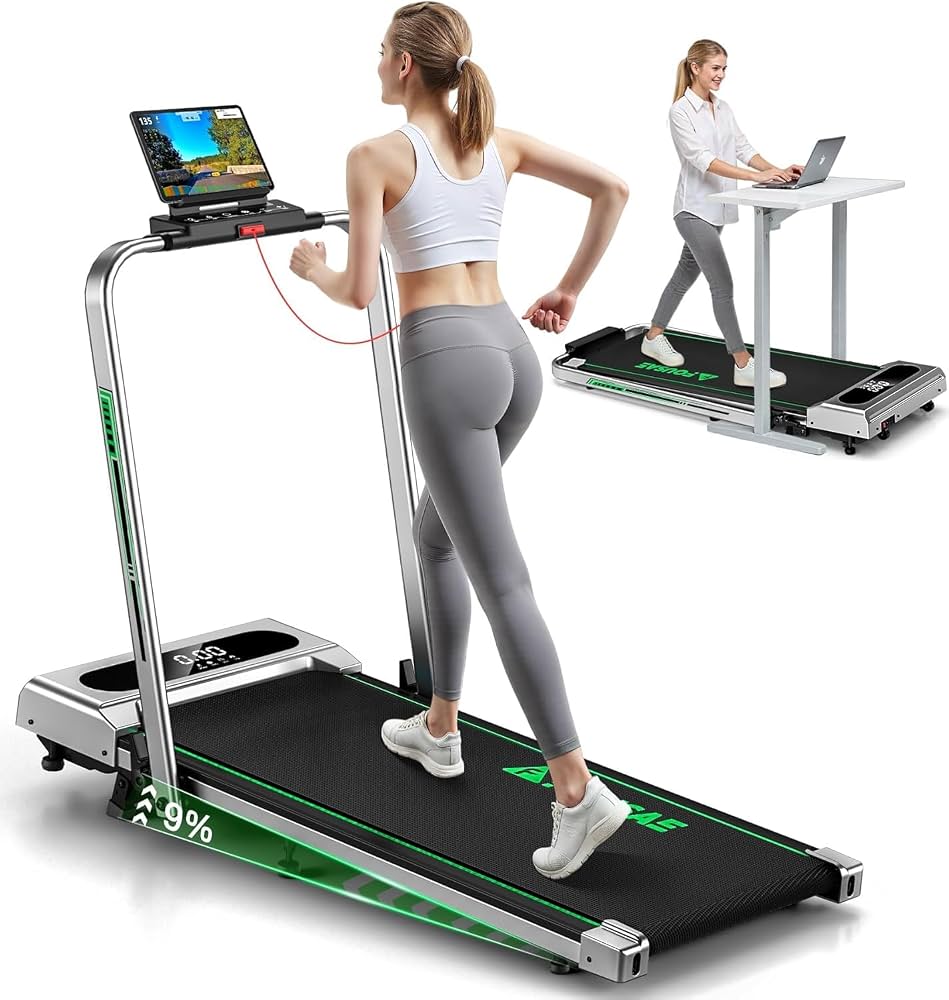
(not me in the image, obviously :-) )
The name of the game is to spend less time sitting. The studies agree: prolonged sitting is bad for the metabolism and the heart, and even light walking during desk work improves the numbers (Mayo Clinic NEAT study, Cleveland Clinic). A walking pad is the lazy, home-friendly way to get some of that.
Why a walkpad, and not a treadmill?🔗
Because you do not run on a walking pad. You walk, at speeds up to jogging pace. And for walking, a full treadmill is overkill: it is bulky, heavy, very expensive, noisy, and its console full of buttons serves no purpose. A walking pad is cheaper, quieter, weighs 30-50 lbs, and fits under the couch. That is the whole point: it is there when you want it, out of sight when you do not.
And why not just walk outside? Because outside I get bored instantly, and become a meal for tiger mosquitoes. My walking pad lets me combine a workout for both mind and body, independent of the weather.
Also, the pad setting the pace for you is what makes it great compared to indoor bikes, manual treadmills, rowing machines, etc. You do not have to think about your workout.
Which one to buy?🔗
There are many brands selling what are essentially the same machine (Urevo, Sperax, DeerRun, Costway, Kingsmith, GoPlus...), and the prices range from cheap to silly. A lot of advice exists, and this reddit thread on cheap walking desks vs expensive ones gives a good feel of the issues — but read also the comments: they report feedback after months or years of use. There is also a handy summary of the offers made by a redditor.
My own advice, after research and months of daily use:
- Brushless motor for reliability and silence. This is the first thing to check.
- Standard Bluetooth FTMS protocol, so that any app can drive it. This is crucial for geeks like me: I wrote my own app, walkpadspeed, that drives my pad through my own routines. Without the standard protocol, you are locked into the vendor's app — often with subscriptions and bugs. With it, any good free app works.
- High weight capacity is an indication of sturdiness. Check the listed max weight.
- Incline matters. Being able to incline the pad is great: you get the same workout at a lower speed, so less noise, less stress on the gear. Manual incline is OK — automatic systems are heavier and bulkier to store, and not worth the tradeoff in my opinion.
- 6 support points beat 4 Having more support points brings greater reliability, as there is less flexing of the frame. Prioritize a solid, low-flex frame with firm rubber shock pads over a soft, springy walking surface for hardware longevity.
- Good shoes and a mat give you a lot of shock absorption in any case, but is especially important with a low-flex frame. Slip-in shoes (e.g. Skechers) are especially nice if you have health issues.
- On cheap models, prefer many short sessions instead of a long one, to avoid motor overheating.
A note about the "slides under the couch" selling point: sliding is actually a bit tricky, as you have to tilt most pads to use their wheels, and tilted, it does not fit under the couch. My solution was to create a sliding mat by gluing (with double-sided tape) a cheap skating slideboard under a cardboard sheet, and now the pad slides effortlessly under the couch.
Some walkpads can fold in half and do not need to be tilted to use the rollers, so they can slide under a couch more easily, but some reviews say the folding can be felt underfoot while running, and is not pleasant.
My choice🔗
For what it is worth, I am quite satisfied with my Fousae ZX-390, a simple entry-level pad. I bought it favoring mechanical qualities over sophisticated features, and it has everything I need: brushless motor, FTMS protocol, manual incline. Other brands sell similar pads.
Plus points:
- it has 6 feet instead of 4, making it more durable — the deck does not flex — as the middle feet are positioned just where your feet land on the pad.
- it has a lubrication hole to pour the silicone oil into the belt, instead of having to deal with the messy operation of spreading it by hand.
- the motor housing at the front limits the length of your stride, compared to the rare models without it.
Minus points:
- its belt is thinner than a high-end treadmill's, so walking barefoot will give you blisters fast
- no automatic incline: either 0% or 9%.
- its speed is limited to 6 km/h. To get to 12 km/h you have to raise the handlebar.
- to work at a desk, you cannot remove the handlebar; you have to fold it, and you can hit your heels on it.
And of course, I wrote walkpadspeed to drive it, which I just released as v1 — see my announcement post. It loads routines from simple text files, and can even adjust the speed automatically to keep my heart rate in a chosen zone.
My advice🔗
- You need to get used to it. Make short sessions at first, 0% incline, at very slow speeds, and raise the speed progressively each day, e.g. by 0.2 km/h.
- Once comfortable with it, you can set the incline to 9% and keep it there.
- Not all kinds of work are realistically doable on a walking pad. Avoid tasks that need precise mouse movements.
- Maintenance is essential. Oil it regularly and avoid dust and carpet lint.
- I use shoes, but walk barefoot once daily on one of my 15mn post-meal sessions. It keeps my feet in shape for surfing, where I walk a lot barefoot to get in and out of the water, but it is not enough to develop blisters or joint pains. However, you should not attempt to walk barefoot in your first month!
- I do not use socks for convenience (I only wear slaps at home), I just put my shoes on a gentle air blower I use to dry my wetsuit boots, to keep them sane.
My routines🔗
Since the pad is always available, I built a small weekly program around it. Here are the routines I use the most:
- Short Digestive: a 15mn relaxed walk, done 15mn after each meal (thus 3 times a day), to lower the glycemic charge — the spike in sugar, and thus insulin, in the blood. It keeps the heart rate in "Zone 0", because walking faster triggers the liver to release sugar in the blood, anticipating a need. It is also called a... Fart Walk! You can stop after just 5mn with most of the benefits, or lengthen it if you are watching a captivating video.
- Z2 40mn: the recommended brisk walk, the most efficient to burn fat. Must be done on an empty stomach. Staying in Zone 2 mobilizes fat burning without the stress of a faster walk or jog that triggers a cortisol spike and prevents fat burning. It boosts endurance and metabolism. I do it 2 to 3 times a week.
- Japan IWT 38mn: the famous Japanese Interval Walking Training has proven extremely effective at enhancing cardio and fitness, and is a practical solution for walking pads, which are not designed to resist actual running. I do it once a week.
Thus, my weekly schedule is 3 digestive walks after each meal, and per day of the week:
- Japanese IWT
- Zone 2
- Resistance training
- Zone 2
- Resistance training
- Zone 2
- Rest, or resistance training if I feel like it
Resistance training for me is short (20mn) but at the highest intensity, as I am over 60.
Two hours of episodes, one workout. I would not go back.