After some experiments, I think I have found an easy way to have a good lateral balance on a small board. A small board being one with little lateral stability, be it because it is narrow, have thin rails, low volume, ...
Your front foot must be parallel to the stringer, and:
the less the board is stable laterally, the less distance it must have from the stringer.
The back foot will naturally position itself symmetrically wrt the stringer, so you actually only have to focus on the front foot.
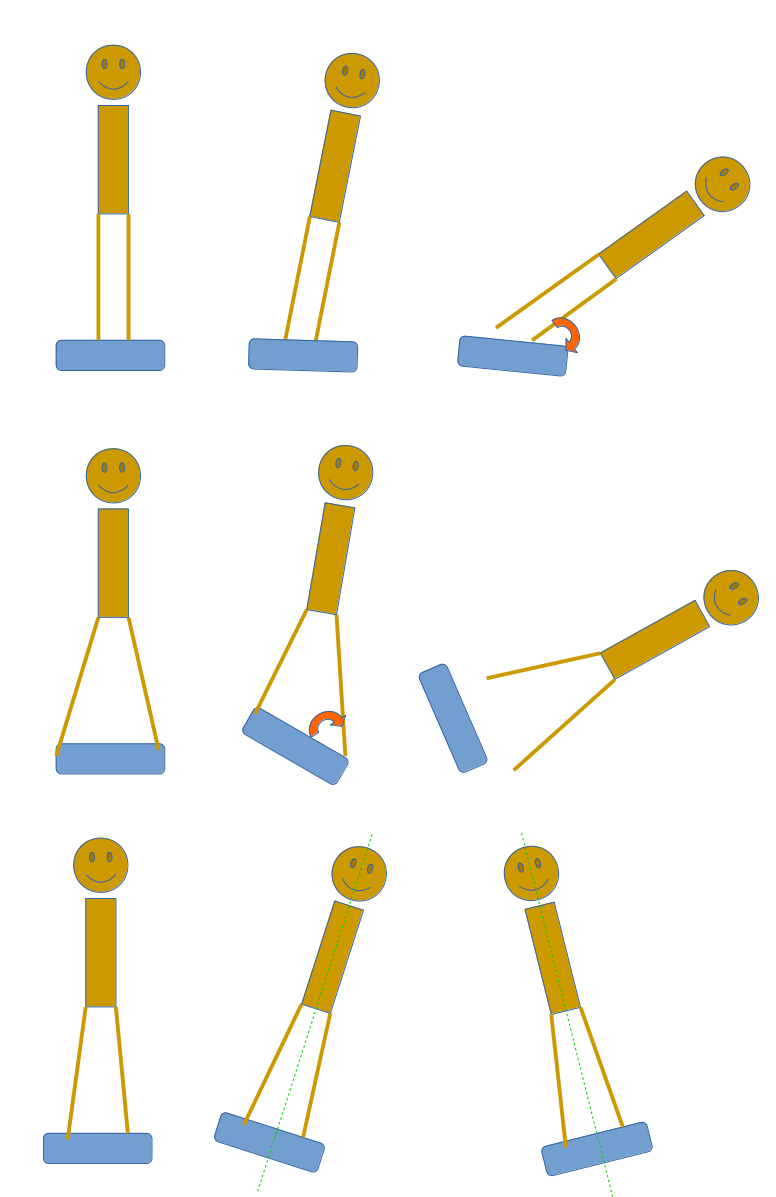
To find this magic position, look at the following diagram:
- top row: if your feet are too close together, when you lean on one side, the leverage on the board will be not strong enough to make it roll at the same angle as your body: you feel the urge to widen your stance to keep balance
- middle row: if your feet are too wide apart (the problem of most people), when you lean on one side, the leverage on the board will make it roll faster than your body and you will be thrown overboard and your low foot will slip.
- bottom row: the perfect position: you will wobble as if your board and you was a solid culbuto toy. You want to be one with your board, as for banking in turns on a bike. Balance suddenly becomes super natural and smooth. It still needs a lot of concentration and it is still tiring, but it is definitively easier.
And once you experience this feeling, it is easy to re-find this perfect foot position by feeling how your board react to your wobbles. It will not feel natural at all at first, but you must resist the urge to widen your stance, you will get quickly used to it.
It is especially useful if your rails are underwater. If your board has too much volume, it will not roll smoothly on its side (it resistance to rolling will vary with the angle), and the foot position is less critical. But for small and/or narrow boards, it is a very convenient rule of thumb to find the quickest way to feel at ease.
In practice this means that your feet are quite close to the stringer:
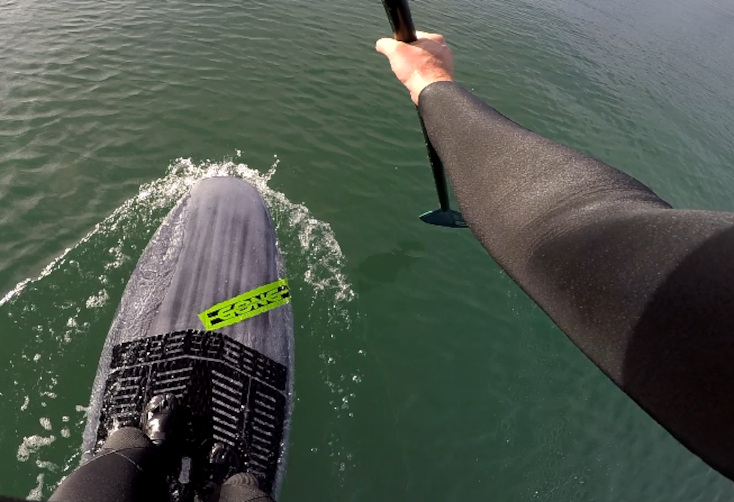
The semi surf stance (front foot aligned with the stringer, rear foot slightly open) is mandatory on small boards, both for paddling balance and early take offs, as I often stress.
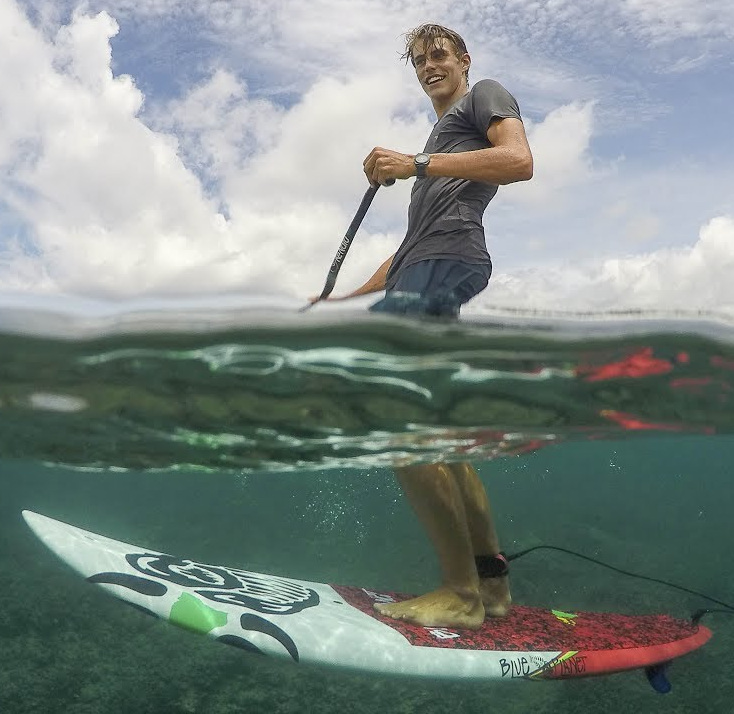
By having the front foot parallel to the stringer there is no difference in lateral balance when your weight moves between your toes and your heel, something that happens a lot unconsciously as you keep your balance. In my experience having your heel closer to the rail than your toes is the recipe for unexpected disaster.
When I advise people I even make it a mandatory condition to get on boards shorter than 8'. You will not benefit from a short board if you do not want to force yourself to stop paddling with parallel feet. A surprising number of people keep paddling parallel on small boards and thus take off really late and miss a lot of waves, or take off too late and a get the wave close on them.
I made a dedicated post for the lateral balance issue because at 59 [at the time I wrote this post], after 10 years SUPing, I felt that the lateral balance was the main thing what I felt worse than when I was younger: I am slower to react. I was thinking that (relatively) narrow boards were not for me anymore. Younger people will be able to put their feet about anywhere, but for most people, I think looking for this lateral balance point will be very useful, as the board moving with you let you more time to react before things need correcting.
This post was originally made at seabreeze on 2019-04-02. You can read the discussions it generated there.